Scholarships
RMAG Foundation Scholarship
The Trustees of the RMAG Foundation may elect to award this scholarship to an applicant demonstrating outstanding research abilities and achievement. There are no restrictions on school affiliation or field of study as long as it is geoscience oriented. The Trustees may not elect to award the Scholarship every year.
For 2026, the Trustees decided to split the RMAG Foundation scholarship and award it to two applicants:

Samantha Khatri, Ph.D. Candidate, Geology, South Dakota School of Mines and Technology
Samantha’s project aims to resolve conflicting interpretations of climate change during the Eocene–Oligocene Transition (EOT) by focusing on terrestrial records from the White River Group (WRG) in South Dakota and Nebraska. While marine data clearly show global cooling, land-based evidence is inconsistent and poorly dated. Samantha proposes that carbonate-rich lake (lacustrine) deposits in the WRG can serve as a high-resolution archive of continental climate change. By studying these deposits, the project seeks to determine whether inland climates cooled during the EOT and how environmental conditions varied across regions and elevations.
Her study combines fieldwork, geochemical analysis, and geochronology. Samantha will measure stratigraphic sections, map lake deposits, and analyze carbonate samples using stable isotopes, clumped isotopes (for temperature), and elemental composition (for hydrology and aridity). U-Pb radiometric dating will provide precise ages, allowing climate changes to be placed in a clear timeline. Together, these methods aim to reconstruct temperature, precipitation, and elevation effects, producing a detailed and time-constrained record of terrestrial climate change and improving understanding of how inland ecosystems responded to global climate shifts.
Samantha’s work is under the direction of Dr. Sarah Keenan.
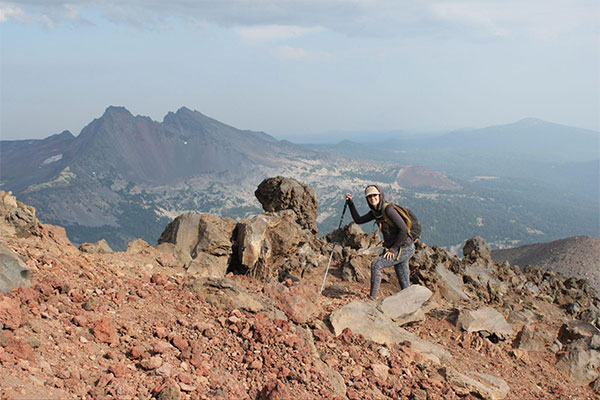
Maggie Moss, Ph.D. Candidate, Geosciences, Colorado State University
Maggie’s work examines the evolution of Yellowstone’s basaltic magmatic system across three caldera cycles by studying the Junction Butte Basalt of the Narrows, and Undine Falls units. Maggie addresses the poorly understood basaltic “roots” of the system by integrating field observations with geochronology, petrology, and geochemistry. The central hypothesis is that Yellowstone’s magmatic system matured over time, evolving from deep, rapid ascent with little storage to a more complex system with multi-level crustal storage and longer residence times. This is tested through high-precision 40Ar/39Ar dating, melt inclusion barometry, thermobarometry, and diffusion chronometry to constrain eruption timing, storage depths, and magma ascent rates.
By combining geochemical and isotopic analyses with mineral-scale timescales, Maggie links magma sources, storage conditions, and transport processes through time. This study provides one of the first time-resolved, basalt-focused frameworks for understanding how basaltic systems evolve beneath large silicic volcanic centers like Yellowstone, with direct implications for improving models of magma dynamics and volcanic hazard assessment.
Maggie’s work is under the direction of Dr. Lauren Harrison.
Recent winners of the RMAG Foundation Scholarship:
2025 Jessica Hiatt, Colorado School of Mines
2024 Bruno Belotti, University of Idaho
2023 Molly McCreary, University of Utah