Scholarships
Stone-Hollberg Scholarship For Structural Geology Research
The Stone-Hollberg Scholarship is awarded to a graduate student at any accredited college or university who is conducting structural geology or geophysics research in the Rocky Mountain region. It was established with generous contributions by Donald Stone and John Hollberg, two Rocky Mountain structural geologists. Don Stone spent sixty years in the oil and gas business, specializing in structural geology and seismic interpretation of the Rocky Mountain foreland province. He is recognized for his detailed structural cross section restorations, especially when he teamed up with his colleague, John Hollberg, to digitize the Wyoming Transect. The Transect is a detailed structured cross section across the state of Wyoming, originally drawn at a scale of 1:24,000 (1 inch=2000 feet). Don donated a lifetime of career files to the Denver Earth Science Library which are available to the public.
The 2026 Stone/Hollberg Scholarship was awarded to:
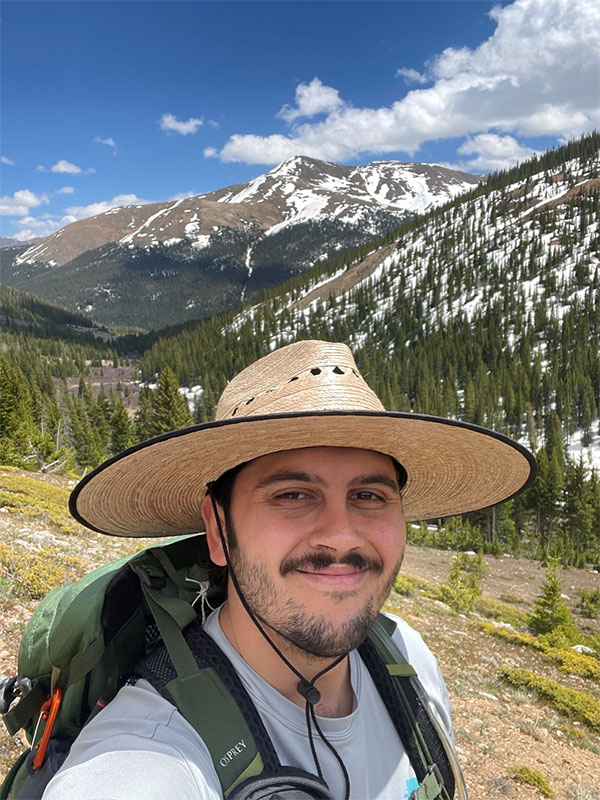
Joshua Thomas Zuniga, M.S., Geology, Colorado School of Mines
Joshua’s study investigates the tectonic origin of 1.4 Ga granites in the Colorado Front Range, focusing on the Silver Plume batholith near the Eisenhower Tunnel. He aims to determine whether the granite formed and was deformed during Mesoproterozoic orogenesis, specifically the Picuris orogeny, or if it reflects an anorogenic setting. By distinguishing Mesoproterozoic deformation from older Paleoproterozoic influences, the work seeks to clarify the tectonic history of the region and evaluate whether the influence of the Picuris orogeny extends farther north than previously recognized.
Joshua integrates detailed field mapping, structural analysis, petrography, geochemistry, and geochronology to address this problem. Fieldwork and GIS-based analysis are used to identify and interpret foliations and deformation patterns, while thin section analysis constrains microstructural evidence of tectonic strain. Whole rock geochemistry and zircon trace element data are applied to determine magma source and tectonic setting, and zircon geochronology provides timing constraints. By combining these datasets, he develops a comprehensive framework linking deformation, magmatism, and tectonic setting, with implications for understanding the origin of 1.4 Ga granites across the region.
Joshua’s work is under the direction of Dr. Yvette Kuiper.
Recent winners of the RMAG Foundation Scholarship:
2025 Alexander Brettmann, University of Utah
2024 Emma Tombaugh, Utah State University
2023 Luke Basler, University of Idaho